Central Intelligence Agency
You Only Live TwiceThe Central Intelligence Agency is the powerful American intelligence service whose technical partnership with Japan and restrictive control of Pacific intelligence shape James Bond’s mission. In You Only Live Twice, it is not simply a source of assistance to Britain: it is also a rival whose priorities, security concerns, and control of information determine the narrow route by which British intelligence can act.
Technical Partnership and Intelligence
Since the war, Japan has built advanced codebreaking machines under the Central Intelligence Agency’s guidance. M describes them as far ahead of IBM’s equipment and says that, for the previous year, Japanese analysts have been reading high-level Soviet traffic from Vladivostok and eastern Russia. The intercepts cover diplomatic, naval, and air-force communications, making Japan’s capability a strategic asset rather than a limited technical resource.
That capability gives the Central Intelligence Agency indirect control over information it does not itself collect: the Japanese service holds the intercepted material, while American guidance and influence shape the context in which Britain can seek access to it. Bond’s assignment therefore begins with an intelligence product already moving through a chain of collection, decoding, and restricted distribution. The value of that product depends not only on what the messages say but on who can see the original traffic and how much of it is passed on.
Pacific Policy and Security
M explains that the Central Intelligence Agency treats the Pacific as its private preserve and does not routinely share its Japanese intelligence with Britain. Under Allan Dulles, the British had at least received digests of material that concerned them; under McCone, that practice has been curtailed. McCone tells M that he is acting under orders from the National Defence Council, which is worried about British security. M accepts that the Americans have grounds for concern even as he resents the restriction.
The stated security rationale is rooted in defections: two senior American cryptographers had defected a couple of years earlier, and M believes they may have exposed material the British had supplied to the Americans. He contrasts the public scrutiny faced by British intelligence with the secrecy he associates with Soviet counterintelligence. This is M’s explanation of the institutional problem, not evidence that the Central Intelligence Agency’s suspicions are baseless: the scene presents an alliance in which cooperation is constrained by each service’s exposure to the other’s failures.
The British position is especially weak because Britain has had no station in Japan since 1950 and has relied on the Central Intelligence Agency to do its work in the region. M describes the Americans as efficient and helpful in that arrangement, but their efficiency does not remove the political cost of dependence. When the agency narrows access, Britain lacks its own local collection network and must seek a new intermediary.
Rivalry and the British Workaround
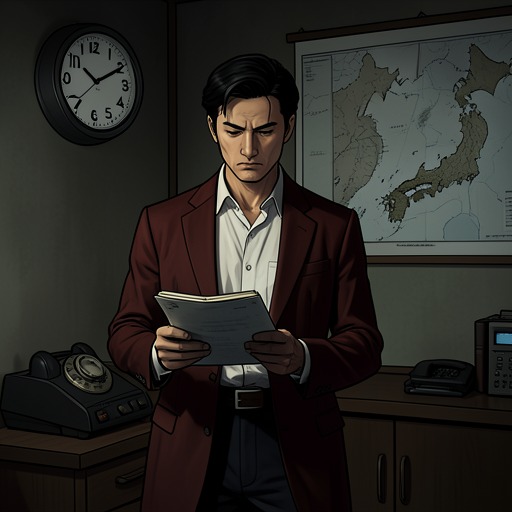
M sends Bond to approach Tiger Tanaka, head of the Japanese Secret Service, and obtain the intercepted material directly. The plan is deliberately indirect: Bond will travel under Australian cover as Richard Lovelace Henderson’s deputy, while Tanaka is expected to arrange a way for the information to reach the Australian Embassy. Britain offers the product of Station H in return, including access to its high-grade Macao link, the Blue Route; Henderson would send material onward through Melbourne.
The arrangement is designed to keep the Central Intelligence Agency from learning of the approach. M recognizes that Tanaka may prefer his existing relationship with the Americans, and that he could report the British proposal to them. If Bond is exposed, Britain intends to rely on the Australians to absorb the political consequences. M also argues that the Central Intelligence Agency has crossed wires with Britain elsewhere, sometimes dangerously, and that those cases could be used in a dispute if the operation caused trouble. The plan thus rests on a contradiction: Britain wants to bypass American control while depending on another allied service to protect it from the fallout.
Tanaka quickly recognizes the maneuver. In conversation with Bond, he compares the American hold over the Pacific to ownership of a private garden and understands that Britain is trying to borrow access without the Central Intelligence Agency’s knowledge. His perceptiveness makes clear that the British operation is not concealed merely because it is unofficial. The agency’s regional dominance is visible to the Japanese official whose cooperation Britain needs.
Source Integrity and Narrative Significance
The dispute concerns not only access but the quality of the intelligence that survives transmission. When Tanaka gives Bond a highly classified message, Bond argues that rewriting it to conceal its source would diminish its value: a reader of the enemy’s own words can assess the evidence differently from a reader of a filtered report. He fears that Washington might pass a garbled version to London—or might remain silent about a threat to Britain—while Britain loses time it could use to prepare a response. His proposed example is advance planning to intern Soviet citizens if the evacuation measures mentioned in the message begin.
The Central Intelligence Agency is therefore represented through competing demands that cannot be cleanly reconciled. Restricting distribution can protect sources and limit exposure after defections; the same restriction can leave an ally with delayed, diluted, or incomplete warning. The novel makes this tension concrete through the route the information must travel: Japanese intercepts, American control of Pacific sharing, Tanaka’s decision, Bond’s covert approach, and the proposed Australian channel back to Britain. The agency’s influence shapes the mission even though Bond’s objective is to keep it outside the transaction.